
How Iosco County Court Records Begin After a Jail Arrest
Court records after a jail arrest in Iosco County usually begin after a person is booked at the Iosco County Jail and the Prosecuting Attorney reviews the law-enforcement report. The jail is operated by the Iosco County Sheriff's Office at 428 W. Lake Street in Tawas City. Jail staff can tell family and friends whether a person is lodged and the amount of bond or fines needed for release, but the jail page does not publish a public online case file or full charge history.
The criminal court record is different from the booking record. The booking side answers custody questions, release questions, and whether someone is presently lodged. For that workflow, use Iosco County jail inmate records. Booking photos and photo requests are handled separately, and the local research found no official public mugshot gallery, so use Iosco County jail mugshots for that topic. The court side follows the charges filed by the prosecutor, the hearings held in district or circuit court, and the final disposition of each charge.
Iosco County criminal cases are split by jurisdiction. The 81st District Court handles misdemeanor criminal cases, felony preliminary hearings, traffic matters, and bond-related early case steps. Felony and serious-misdemeanor cases can move to the 23rd Judicial Circuit Court after the district-court stage. Michigan uses a Prosecuting Attorney, not a district attorney. In Iosco County, Prosecuting Attorney James A. Bacarella is the local official whose office issues felony charges, misdemeanor complaints, and search warrants.
How to Find Court Records After an Iosco County Arrest
Iosco County court pages link users to MiCOURT Case Search for public case lookup and hearing information. MiCOURT is the statewide court portal, while the local court clerks remain the source for docket questions, certified copies, payment questions, and record-access limits. A recent arrest may not appear instantly because booking, prosecutor review, complaint filing, arraignment, and docket entry are separate steps.
The MiCOURT case-search entry point is the official public portal linked by the Iosco court materials.
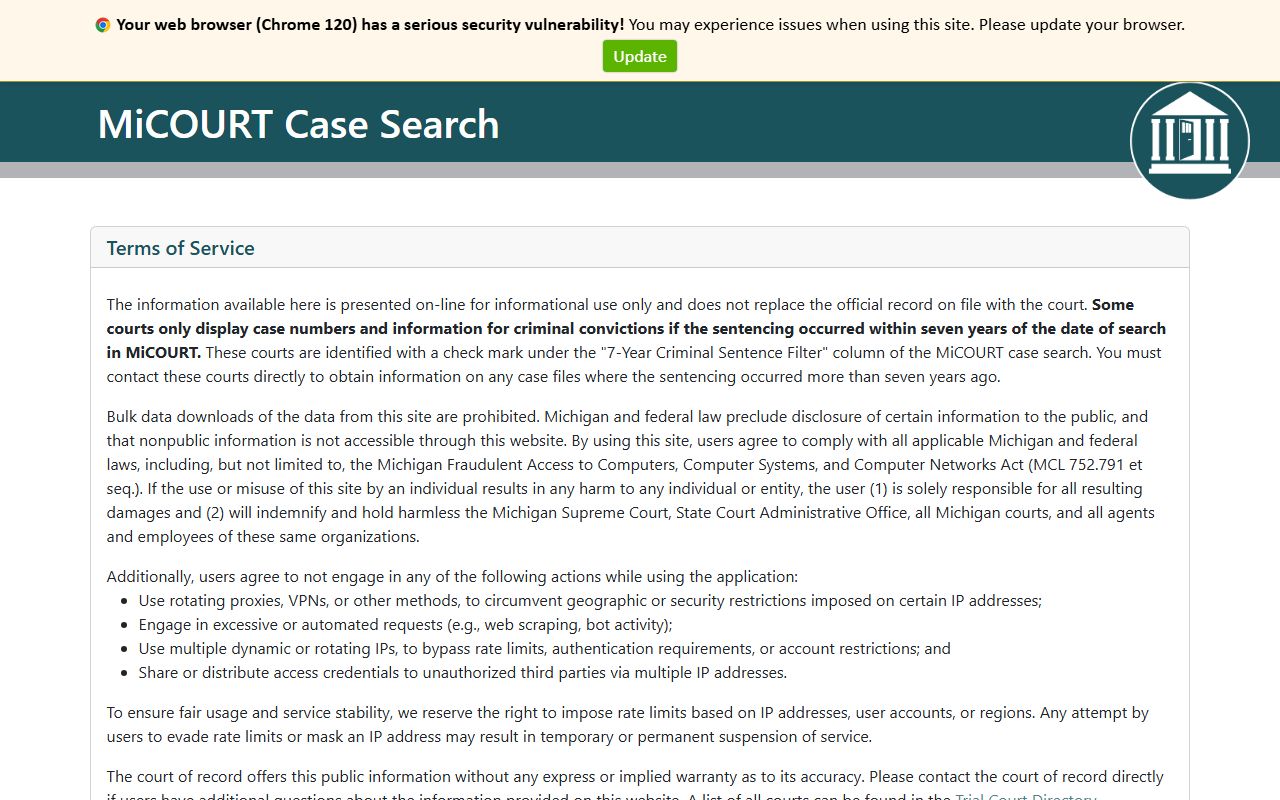
Use the case-search portal for charge and hearing information, then confirm unclear case status with the court clerk listed on the case.
- Open MiCOURT Case Search and choose the appropriate Michigan court search path.
- Search by defendant name when the case number is unknown, or by case number when paperwork or a notice provides it.
- Review the court name carefully. Iosco misdemeanor cases and felony preliminary matters may appear under the 81st District Court; felony cases may later appear under the 23rd Circuit Court.
- Open the case and read the charge list, hearing dates, bond entries, attorney entries, and disposition lines.
- Compare each filed charge to any booking or jail information. The court charge record can differ from the initial arrest allegation.
| MiCOURT Search Field | How It Helps After an Arrest | Notes for Iosco County |
|---|---|---|
| Court | Filters the search to the court that has the criminal case. | Use 81st District Court for misdemeanor and felony preliminary stages; check 23rd Circuit Court for felony or serious-misdemeanor proceedings after bindover. |
| Party name | Finds cases when only a defendant name is known. | Use full legal name and try spelling variations if the arrest paperwork is unavailable. |
| Case number | Finds the most precise docket entry. | Best when supplied by a citation, court notice, bond receipt, attorney, or clerk. |
| Case type | Separates criminal cases from civil, traffic, domestic, and probate matters. | Availability depends on the MiCOURT search screen and selected court. |
| Date filters | Narrows recent-arrest or hearing-calendar searches. | Useful when checking arraignments, preliminary exams, or recent docket movement. |
Charging Documents in Court Records After a Jail Arrest
An arrest allegation does not become a full court case by itself. After the report reaches the Prosecutor's Office, the prosecutor decides what charge or charges to issue. The official Iosco prosecutor page says the office issues all felonies and all misdemeanor complaints in the county, prepares files, secures witnesses, and proceeds to trial on criminal matters ranging from traffic offenses to the most serious felony charges.
| Document | Usual Function | Iosco County Context |
|---|---|---|
| Complaint | Starts many criminal cases and states the offense alleged by the prosecutor. | The prosecutor page specifically lists misdemeanor complaints among local duties. Complaints may appear early in 81st District Court records. |
| Information | Formal felony charging document after a bindover, waiver, or other felony-case step. | Felony cases can move from district court preliminary proceedings to the 23rd Circuit Court. |
| Indictment | A grand-jury charging document used in some serious criminal matters. | Less common in routine local docket review. Confirm with the circuit court clerk if a case record references an indictment. |
The charge document matters because it can replace or narrow what was first discussed at booking. A person might be arrested on one suspected offense, charged with another, or have charges added, reduced, or dismissed after review. For that reason, court records after an arrest should be read charge by charge, not just by the booking label.
Charge Status in Iosco County Court Records
Charge status tells whether an allegation is still pending, has been changed, or has reached an outcome. Early court records may show only arraignment, bond, and next hearing. Later records can show amended charges, dismissed counts, plea results, trial outcomes, sentencing entries, or transfer from district court to circuit court. A charge can also remain pending while a warrant, failure-to-appear issue, probation matter, or bond violation is unresolved.
| Status | What It Means | What to Check Next |
|---|---|---|
| Pending | The charge is active and no final disposition is shown. | Look for the next hearing, bond conditions, attorney entry, and court location. |
| Amended or reduced | The filed charge has been changed, often by plea agreement, prosecutor decision, or court order. | Compare the original charge, amended charge, and disposition line. |
| Dismissed | The court record shows that a charge or count was dismissed. | Check whether other counts remain active and whether the dismissal was with or without conditions. |
| Bound over | A felony case moves from district court preliminary stages to circuit court. | Search the 23rd Circuit Court record if the district record stops after bindover. |
| Convicted or pled | The case reached a conviction through plea or verdict. | Review sentencing, probation, jail credit, fines, costs, and any MDOC routing. |
Bond and Release Entries After an Arrest
Iosco County publishes detailed bond instructions. Bonds can be posted 24 hours a day for an inmate in the Iosco County Jail who has local or in-state charges, including Friend of the Court bonds. The jail number, (989) 362-6164, is the source for the amount of bond set by the court. Court records may show the bond order, but the jail confirms what amount is needed for release and whether another hold blocks release.
| Bond or Release Type | How It Works Locally | Practical Check |
|---|---|---|
| Cash bond | Iosco accepts cash, but staff cannot make change, so exact amount is required. | Call before arrival to confirm the amount and whether cash is permitted for that case. |
| Surety bond | A licensed bonding agent authorized by the court may post the bond. | Confirm the court has authorized surety before paying an agent. |
| Credit card or online | Iosco uses JailATM.com through a lobby kiosk or remote payment from home. | Confirm fees and payment posting details with JailATM and the jail. |
| Friend of the Court bond | The county bond page specifically includes Friend of the Court bonds. | Ask whether the payment is tied to a domestic-relations or support matter. |
| No-bond hold or detainer | Payment may not release the person if a court, warrant, probation, parole, or outside-agency hold applies. | Check the jail, court clerk, and any supervising agency before assuming release is available. |
The county bond page also notes a $12 booking fee required by law and states that sentenced inmates are charged $20 per day while lodged under the Prisoner Reimbursement to the County Act. Those costs are separate from the question of whether the criminal charge is pending, dismissed, or resolved.
Warrants That Create Court Records After an Arrest
No official public Iosco County active-warrant search was found in the county sources reviewed. The sheriff's homepage states that Control Center personnel hold and maintain Iosco County warrants, handle sex-offender registration procedures, and help locate parole violators. The Prosecutor's Office page states that the prosecutor issues all search warrants in Iosco County.
If a warrant leads to booking at Iosco County Jail, the jail can confirm lodged status and bond or fines amount. The underlying court record should then be checked through MiCOURT or the clerk. Bench warrants often connect to missed court or violated court orders. Arrest warrants connect to criminal complaints. Search warrants are investigative tools and usually are not the same thing as a public custody roster entry.
Charges vs. Convictions in Court Records After an Arrest
A charge is an accusation filed in court. A conviction is an outcome after a guilty plea, no-contest plea where accepted, or verdict. Iosco County court records after a jail arrest may show both, but they should not be treated as the same thing. A person can be arrested and charged, then later have a charge dismissed, reduced, amended, or resolved without a conviction on that specific count.
| Comparison Point | Charge | Conviction |
|---|---|---|
| Case stage | Accusation filed by the prosecutor. | Final outcome after plea or verdict. |
| Where it appears | Complaint, information, docket charge list, hearing entries. | Disposition, judgment, sentencing, probation, jail, or MDOC entries. |
| Meaning | The case is alleged or pending unless another status is shown. | The court accepted or entered a finding of guilt on that charge. |
| Can change? | Yes. Charges may be amended, reduced, added, or dismissed. | Can be appealed or later set aside if eligible, but it is a completed adjudication unless changed by order. |
Sealed, Restricted, and Set-Aside Court Records After an Arrest
Michigan uses the term "set aside" for many expungement-style conviction-clearing procedures. MCL 780.621 is the Michigan set-aside statute for eligible convictions, and Michigan Courts provide an application form for eligible conviction set-aside requests. Sealing, restriction, suppression, and set-aside language can mean different things depending on the record type and court order.
| Comparison Point | Sealed or Restricted | Set Aside or Expunged |
|---|---|---|
| Basic effect | Public access is limited by law, court rule, or order. | An eligible conviction is cleared under Michigan procedure after the required order or process. |
| Public lookup result | MiCOURT may not show all details, and clerk access may also be limited. | Public case information may change, but old third-party copies may not update automatically. |
| Common documentation | Court order, confidentiality rule, juvenile protection, or statutory restriction. | Michigan set-aside order or qualifying automatic process when applicable. |
| What it is not | Not proof that the event never occurred. | Not a guarantee that every old screenshot, private database copy, or search-result snippet disappears. |
Public Access Limits for Court Records After an Arrest
Michigan FOIA begins with a broad public-policy statement in MCL 15.231 and a right to inspect, copy, or receive copies of public records in MCL 15.233, subject to exemptions. MCL 15.234 governs public-record fee calculations. Those statutes do not make every jail, law-enforcement, juvenile, biometric, investigative, or court record instantly public online. Active investigations, privacy-sensitive details, juvenile matters, and exempt law-enforcement information can be withheld or redacted.
For Iosco County, the practical access chain is specific. Use the jail for lodged status and bond or fines amount. Use MiCOURT and the 81st District Court or 23rd Circuit Court clerks for court records after an arrest. Use the Sheriff's Office FOIA process for sheriff records beyond the narrow phone disclosure. Use Michigan VINE for custody notifications, MDOC OTIS for state prisoners, BOP for federal prisoners, and ICE ODLS for immigration detention. No confirmed Iosco-specific sheriff app was found in the official county sources reviewed.
FCRA notice: Iosco County Inmate Population is not a consumer reporting agency, and record information may not be used for employment, credit, housing, insurance, or another FCRA-covered decision.
Iosco County Court and Prosecutor Contacts
When a MiCOURT entry is unclear, the clerk for the court that owns the case is the most direct contact. Use the prosecutor for charging-office context, victim forms, restitution forms, and bond-modification forms. Use the sheriff or jail for current custody and bond-payment logistics.
| Office | Address and Contact | Records Role |
|---|---|---|
| 81st District Court | 422 W. Lake St., Tawas City, MI 48763; mailing PO Box 609; phone (989) 362-4441; fax (989) 984-1021; Monday-Friday 8:30 a.m.-4:30 p.m. | Misdemeanor criminal cases, felony preliminary hearings, traffic matters, early bond and hearing entries. |
| 23rd Circuit Court | 422 W. Lake St., Tawas City, MI 48763; mailing PO Box 838, Tawas City, MI 48764-0838; phone (989) 362-3497; fax (989) 984-1012; Monday-Friday 8:30 a.m.-4:30 p.m. | Felony and serious-misdemeanor cases after bindover, circuit-level criminal orders, dispositions, and sentencing records. |
| Iosco County Prosecutor | 422 W. Lake St., Tawas City, MI 48763; mailing PO Box 548; phone (989) 362-6141; fax (989) 984-1106; Monday-Friday 8:30 a.m.-4:30 p.m. | Felony issuance, misdemeanor complaints, search warrants, trial preparation, victim-rights information, restitution and bond-modification forms. |